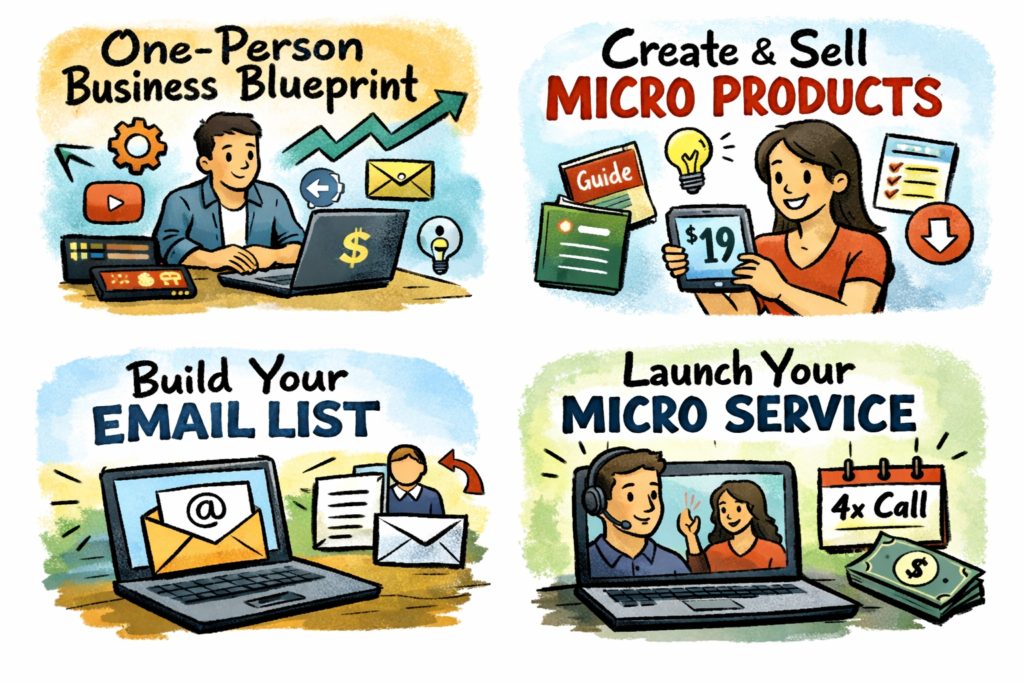
Most people overcomplicate business before they even make their first dollar.
They think they need a logo, a registered company, a website, ads, employees, funding, or some “big idea” that changes the world.
That mindset is exactly why they never start.
If you’re a beginner, the smartest move is not building a startup — it’s building a one-person business.
A one-person business is the most realistic, low-risk, and high-leverage way to start making money online today. You don’t need a team. You don’t need capital. You don’t need permission.
You only need a skill, a system, and consistency.
This guide will show you the simplest possible path to building a one-person business using micro products and micro services, even if:
- You’re starting from zero
- You have very little money
- You don’t have a big audience
- You feel “not ready” yet
Let’s break it down step by step.
Why a One-Person Business Is the Best Starting Point
When you’re just starting out, trying to build something big is usually a mistake.
Big businesses require:
- Capital
- Teams
- Complex systems
- Experience
- Time
A one-person business flips that entirely.
Instead of scale first, you focus on leverage first.
You use:
- Your knowledge
- The internet
- Digital products
- Writing
- Simple tools
That’s it.
Many creators today are already making $1M–$10M per year alone by selling digital products, education, and services online. Technology has removed the need for employees in the early stages.
And here’s the hidden advantage most people miss:
> Once you build a one-person business, you can later expand into anything else — brands, startups, physical products — with an existing audience and income.
Starting small doesn’t limit you.
It unlocks options.
Forget the “Official” Stuff (For Now)
One of the biggest mental traps beginners fall into is worrying about things that don’t make money.
You do NOT need:
- An LLC (yet)
- A fancy website
- A perfect brand
- Complicated funnels
- Legal anxiety
If you haven’t made at least $10K–$50K, your only job is learning how to create value and get paid.
Focus on revenue first. Structure comes later.
Step 1: Build a Simple Digital Tool Stack
Your online business runs on tools — but you only need four.
Nothing more.
A Place to Generate Traffic (Attention) :
The fastest, cheapest, and simplest way to get attention today is writing on social media.
Not ads.
Not SEO blogs.
Not YouTube (yet
Writing wins because:
- It’s free
- It builds skill
- It compounds daily
- It requires zero equipment
- It lets you test ideas fast
Best beginner platforms:
X (Twitter) – deep thinking, leverage, high upside
Threads – beginner-friendly, fast Growth
linkedin – higher income audience, professional tone.
Pick one platform.
Don’t multitask.
Consistency beats everything.
A Place to Collect Emails (Your Real Asset)
Social media is rented attention.
Email is owned attention.
An email list lets you:
- Speak directly to interested people
- Build trust
- Sell without algorithms
- Create predictable income
The simplest setup:
Social media posts → newsletter link
Use a beginner-friendly newsletter platform that allows:
- Email collection
- Basic automation
- Simple landing pages
Your newsletter becomes your home base.
A Place to Get Paid (Products & Services)
You now need one link where people can:
- Buy digital products
- Book services
- Join programs
Avoid complex tech.
Use an all-in-one platform that handles:
- Payments
- Digital downloads
- Landing pages
- Call scheduling
One link. One checkout. Zero friction.
A Place to Think, Write & Organize
Most online businesses are built on ideas and writing.
You need a place to:
- Capture content ideas
- Write posts
- Outline newsletters
- Build products
- Store research
This becomes your second brain.
Without this, your creativity stays scattered.
Step 2: Decide What You’re Building Around
The most common beginner mistake?
Trying to be original.
Originality is not required.Clarity is.
Ask yourself:
- What do I already know more about than most people?
- What have I struggled with and improved?
- What do people ask me for help with?
- What could I explain for 30 minutes without preparation?
You don’t need to be an expert.
You only need to be 1–2 steps ahead of someone else.
Choose ONE Core Skill or Interest

Examples:
- Fitness & body transformation
- Career growth
- Coding / tech skills
- Writing
- Productivity
- Freelancing
- Mental discipline
Then:
1. List 5 creators already succeeding in that space
2. Study what they post
3. Study what they sell
4. Identify gaps or beginner pain points
No invention required.
You are combining proven ideas with your perspective.
3. Start With Micro Products or Micro Services
This is where money actually enters the picture.
Option 1: The Micro Product
A micro product is:
- Low-priced ($9–$29)
- Simple
- Focused
- Fast to create
Examples:
- A short guide (10–20 pages)
- A checklist
- A template
- A swipe file
- A beginner roadmap
If it solves one painful problem, people will buy.
Many creators accidentally sit on monetizable assets:
- Notes
- Systems
- PDFs
- Frameworks
Package it. Price it small. Ship it.
Validation matters more than perfection.
Option 2: The Micro Service

This is the fastest way to make your first serious money.
You sell your time + knowledge.
Examples:
- 4 coaching calls for $750–$1,000
- Skill-based mentorship
- Career guidance
- Systems setup
- Strategy sessions
You don’t need:
- A logo
- A curriculum
- A fancy sales page
You need:
- A clear promise
- A payment link
- The confidence to ask
If people pay, you validate the idea.
Then you refine it into a product later.
Step 4: Create Offer-Driven Content

Content without an offer is just a hobby.
Your content should naturally lead to:
- Your newsletter
- Your product
- Your service
What Should You Write About?
Start with:
1. Your story – before, struggle, after.
2. Pain points – what your audience is stuck on.
3. Proven topics – YouTube titles, viral posts.
Speak like you’re texting a friend.
No fancy words.
No fake guru tone.
Simple Writing Framework (That Converts)
Pain → Process → Result
Example:
- Identify a common struggle
- Explain why it happens
- Share a simple solution
- Mention your product naturally
This works for:
- Social posts
- Newsletters
- Sales emails
Step 5: Promote Yourself (Without Guilt)
Most people fail because they don’t sell.
They write. They post. They stay invisible.
Selling is not evil.
It’s how value gets exchanged.
If you don’t promote:
- People won’t know you help
- You won’t improve
- You won’t learn marketing
- You won’t grow confidence
Ignore the loud minority who hate promotion.
For every negative comment, dozens of people quietly buy.
Final Advice: Permission to Be Bad
Your first product won’t be perfect.
Your writing will feel awkward.
Your audience will be small.
That’s normal.
Every successful one-person business started messy.
The only real failure is not starting.
Write daily.
Promote weekly.
Improve continuously.
That’s the game.
4 thoughts on “How to Build a Profitable One-Person Online Business (Step-by-Step)”