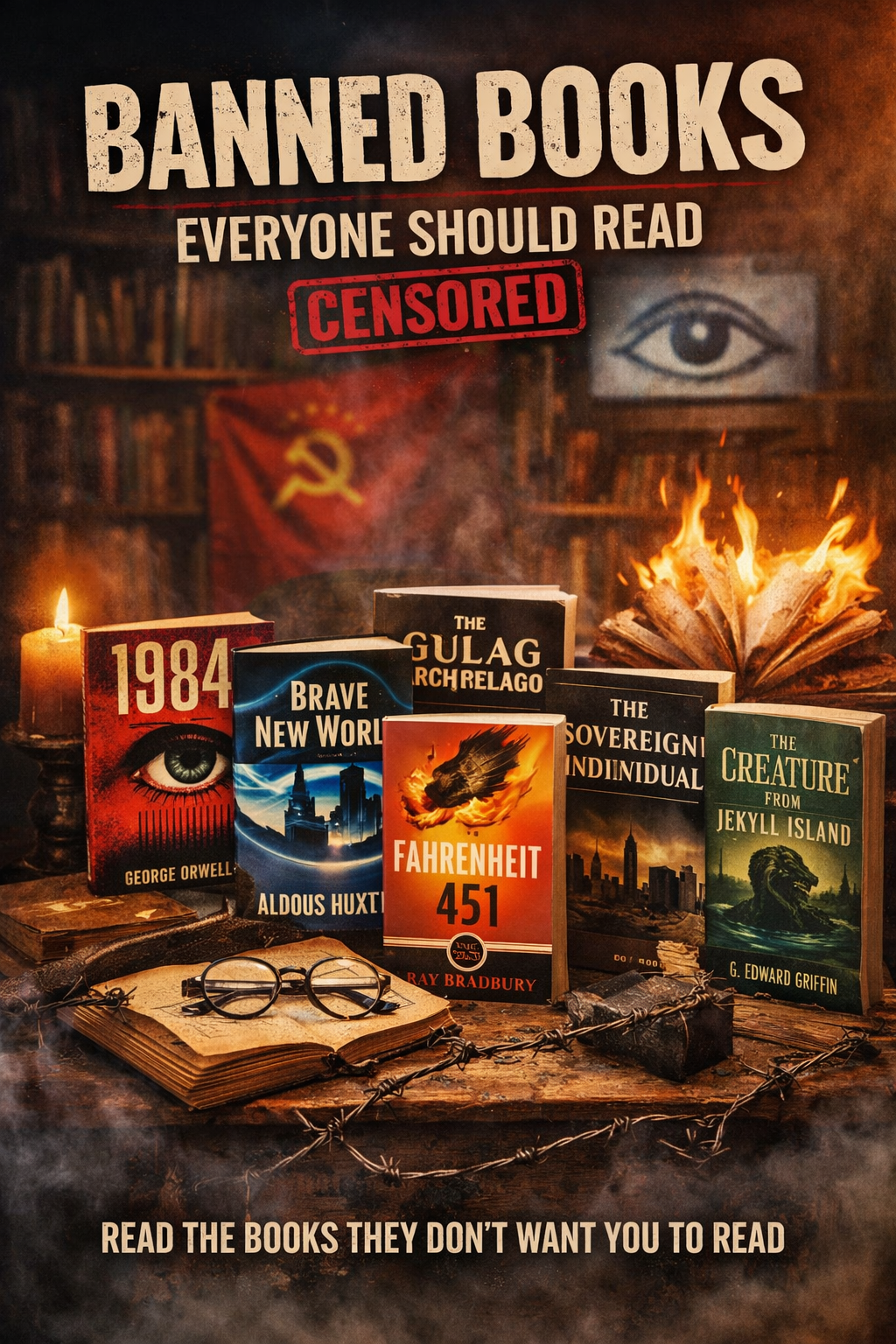
Banned books everyone should read are often the very books that challenge authority, question systems, and awaken independent thinking. Throughout history, powerful institutions have restricted, censored, or criticized certain works because they disrupt narratives and force readers to confront uncomfortable truths.
If you are serious about personal growth, mindset expansion, and understanding how power structures influence society, this list is not just about reading — it’s about awakening. Below are 12 controversial and banned works that have shaped political thought, psychological awareness, financial independence, and spiritual questioning.
List of 12 Banned Books
1. 1984 – George Orwell
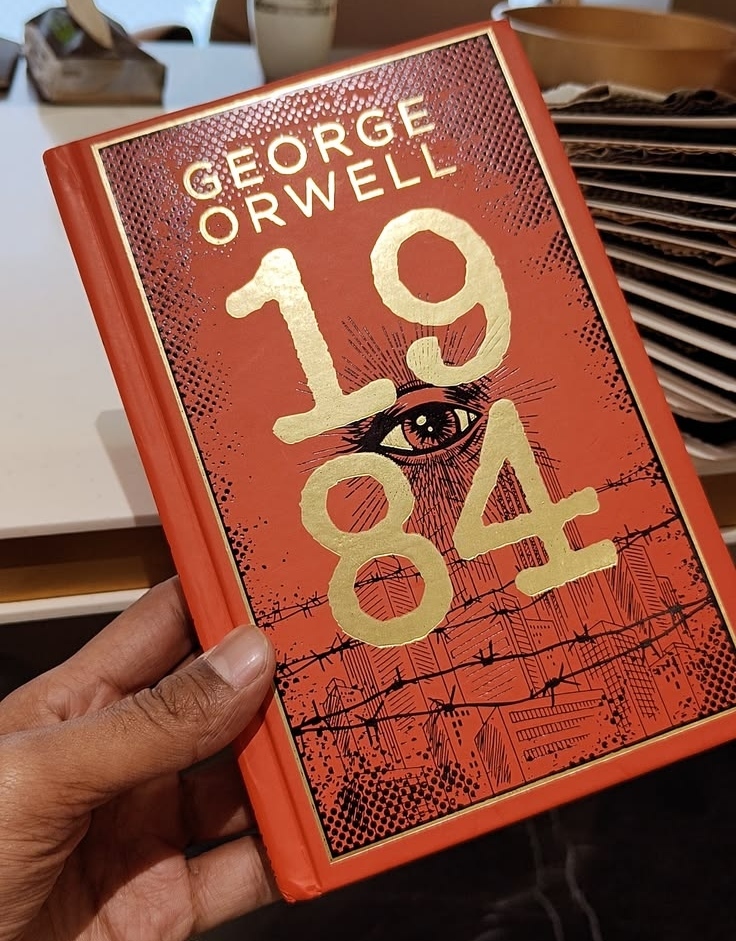
Few novels have influenced political awareness like 1984. Set in a dystopian future ruled by constant surveillance and propaganda, Orwell introduces concepts like “Big Brother,” “thoughtcrime,” and manipulated truth.
The book has been banned in various countries for its political themes and criticism of totalitarianism. Yet, its relevance continues to grow in an era of digital surveillance and information control.
Why read it?
- Understand psychological manipulation
- Recognize propaganda patterns
- Develop critical awareness of authority
2. Brave New World – Aldous Huxley
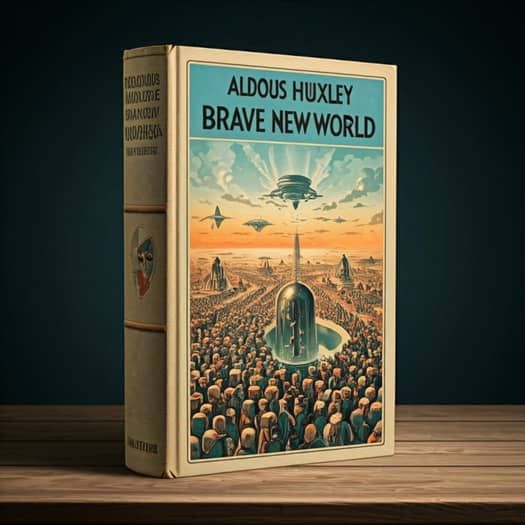
While Orwell warned about oppression through fear, Huxley warned about oppression through pleasure. In this futuristic society, people are controlled through entertainment, conditioning, and artificial happiness.
It has been censored for sexual content and anti-establishment ideas. But its deeper message is about how comfort can quietly destroy freedom.
Why read it?
- Learn how distraction weakens discipline
- Recognize societal conditioning
- Question artificial happiness culture
3. Fahrenheit 451 – Ray Bradburyl
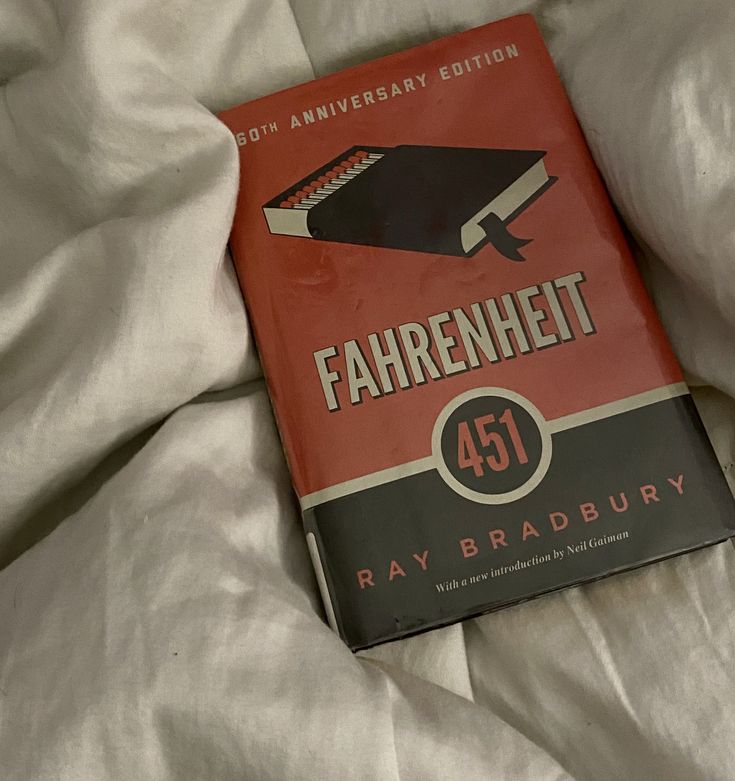
A world where books are illegal and “firemen” burn them. This novel directly confronts censorship and anti-intellectualism.
Ironically, this book about banned literature has itself been banned or challenged in schools across the United States.
Why read it?
- Understand why knowledge is feared
- Appreciate intellectual freedom
- Strengthen your commitment to learning
4. The Gulag Archipelago – Aleksandr Solzhenitsyn
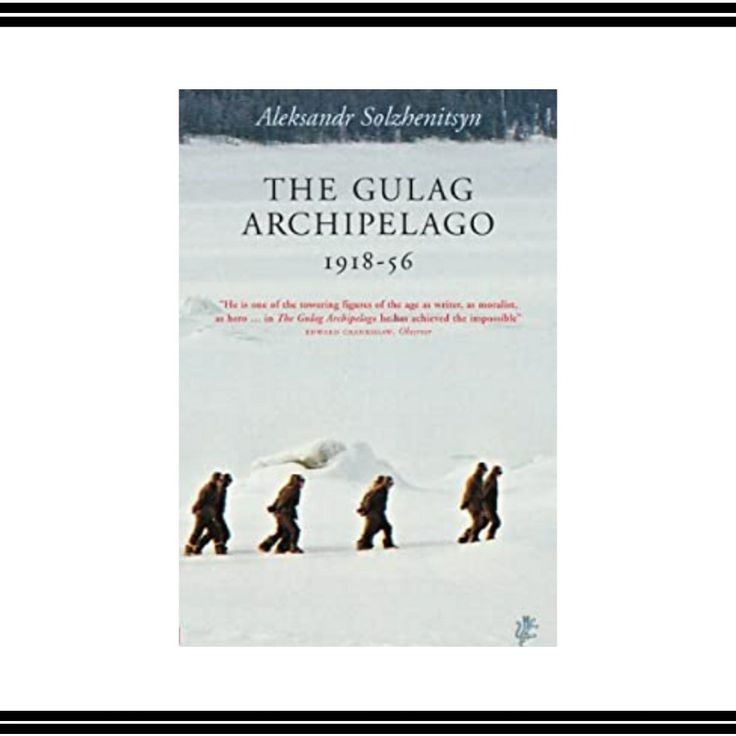
This historical account exposed the brutal forced labor camp system of the Soviet Union. It was banned in the USSR and heavily restricted because it revealed state crimes.
The book is not light reading. It’s intense, emotional, and brutally honest. But it teaches resilience, moral courage, and the cost of unchecked power.
Why read it?
- Learn the dangers of authoritarianism
- Develop gratitude for freedom
- Understand the psychological strength of survivors
5. The Sovereign Individual – James Dale Davidson & William Rees-Mogg
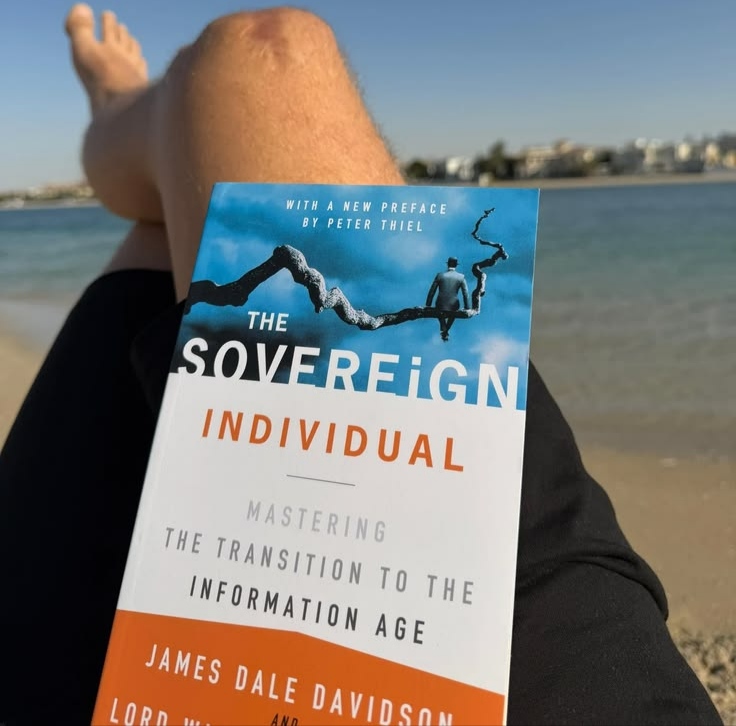
Though not officially banned everywhere, this book is controversial because it predicts the decline of nation-states and the rise of digital sovereignty.
It discusses financial independence, crypto-like systems, and mobility decades before they became mainstream.
Why read it?
- Understand economic shifts
- Prepare for digital transformation
- Think independently about wealth and sovereignty
6. The Creature from Jekyll Island – G. Edward Griffin
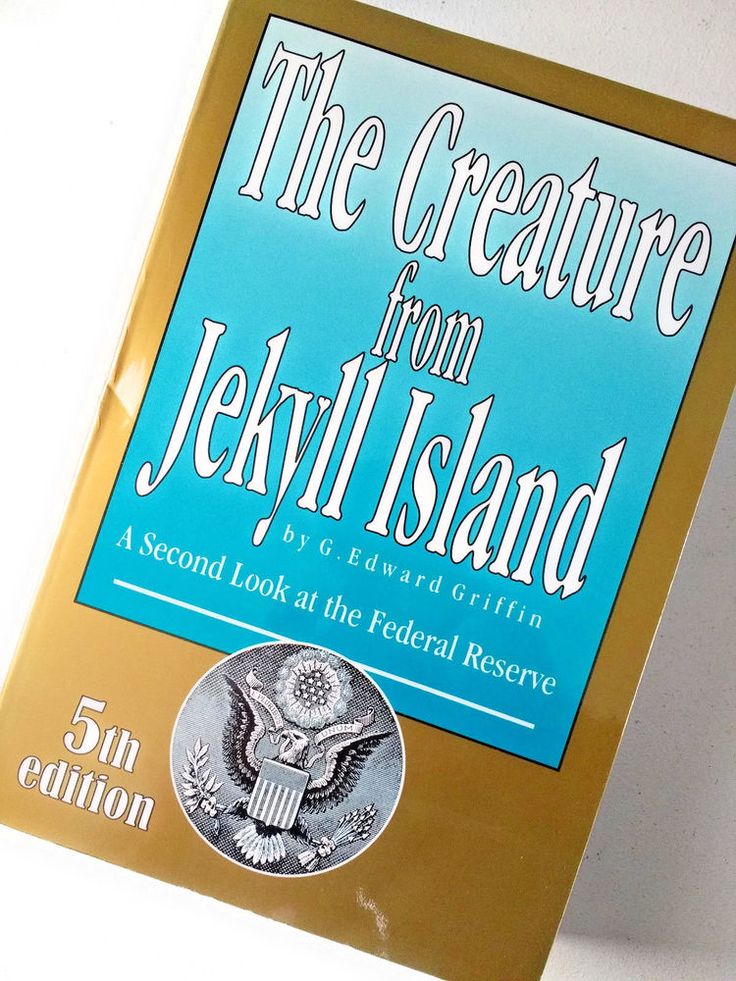
This investigative work critiques the creation of the Federal Reserve System. It has faced criticism and resistance due to its bold claims about banking and monetary power.
Whether you agree or not, it forces you to understand how financial systems operate.
Why read it?
- Increase financial literacy
- Question centralized monetary control
- Expand economic awareness
7. Reality Transurfing – Vadim Zeland
Banned or restricted in some regions due to its unconventional metaphysical ideas, this book explores how intention, perception, and alternative realities shape life outcomes.
It blends quantum-like philosophy with self-development psychology.
Why read it?
- Strengthen belief systems
- Understand mindset mechanics
- Develop intentional living habits
8. Medical Nemesis – Ivan Illich
This controversial critique of modern medicine argues that institutionalized healthcare can sometimes cause more harm than good.
It was heavily criticized and debated upon release.
Why read it?
- Develop critical thinking about health systems
- Take responsibility for personal wellness
- Question blind trust in institutions
9. The Mass Psychology of Fascism – Wilhelm Reich
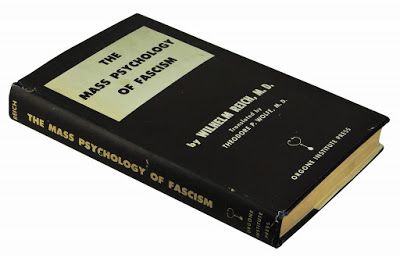
Reich analyzes how psychological factors allow authoritarian systems to rise. The book was banned and even burned in Nazi Germany.
It connects politics with suppressed emotions and societal conditioning.
Why read it?
- Understand crowd psychology
- Recognize emotional manipulation
- Strengthen independent thought
10. The Egyptian – Mika Waltari
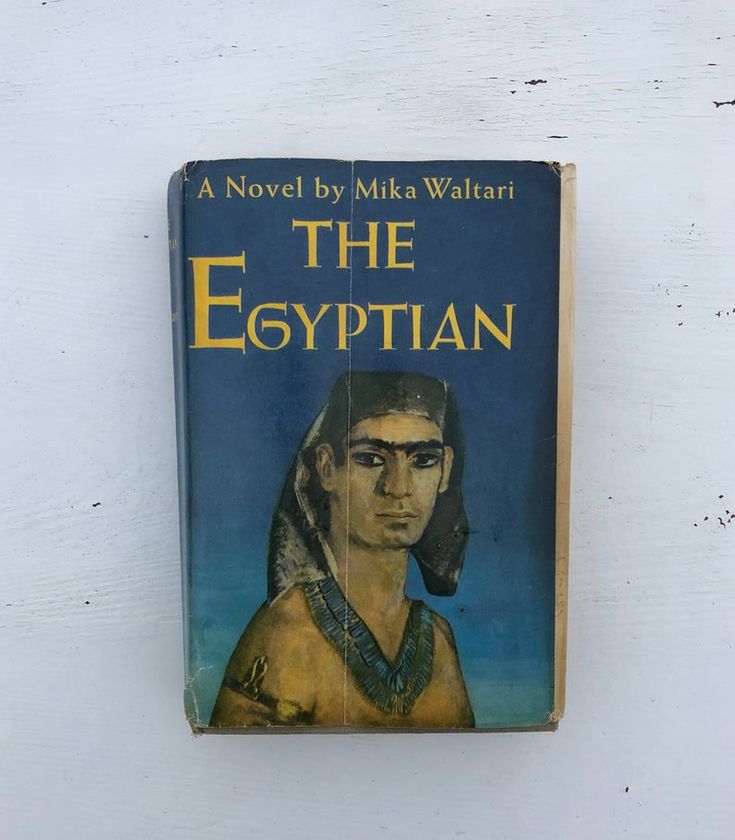
A historical novel exploring ancient Egypt, morality, power, and human nature. Some regions criticized it for religious and political undertones.
Beyond history, it’s a philosophical reflection on ambition and fate.
Why read it?
- Explore timeless leadership lessons
- Reflect on morality and ambition
- Gain historical perspective
11. The Adam and Eve Story – Chan Thomas
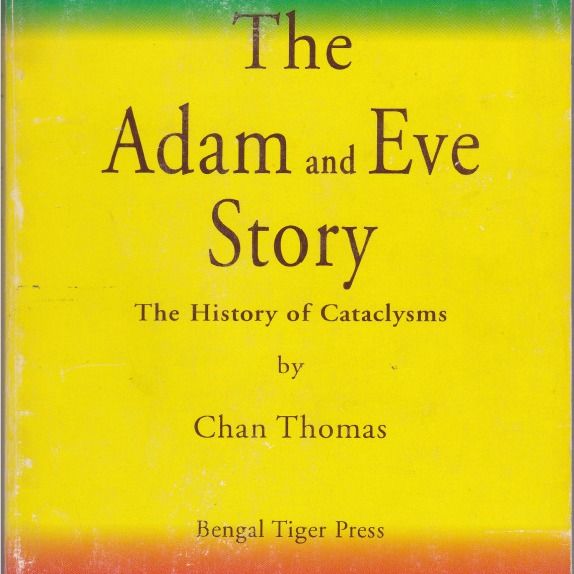
This controversial book discusses catastrophic earth cycles and hidden historical theories. It has been partially classified and restricted in the past, increasing its mysterious reputation.
Whether viewed as speculative or serious theory, it pushes readers to question accepted narratives.
Why read it?
- Encourage open-minded research
- Explore alternative history
- Develop curiosity beyond mainstream education
12. Tyndale Bible – William Tyndale
One of the earliest English translations of the Bible, this work was banned by church authorities in the 16th century. William Tyndale was executed for translating scripture into English.
This historical event represents the power struggle over knowledge accessibility.
Why read it?
- Understand the history of religious freedom
- Appreciate access to knowledge
- Recognize the cost of intellectual courage
Why Controversial Books Build Stronger Minds
The pattern is clear: books are banned when they threaten power, challenge narratives, or empower individuals.
Reading controversial literature helps you:
- Think independently
- Analyze authority critically
- Build intellectual courage
- Strengthen mental resilience
- Understand historical cycles
If your goal is personal development, financial awareness, discipline, and sovereignty — these works act as mental training tools.
Final Thoughts
The most powerful ideas in history were often rejected before they were accepted. Controversial literature forces readers to confront uncomfortable truths, and that discomfort builds mental strength.
Success in life does not come from comfort. It comes from awareness, discipline, and courage to think differently.
If you truly want to grow beyond average thinking, start with one book from this list. Read slowly. Take notes.Reflect deeply.
Because sometimes the ideas that are restricted the most are the ones that expand your mind the furthest.
Thanks for Reading.
Also Read :
How to Build a Profitable One-Person Online Business (Step-by-Step)